Ethanol 96% Compatibility with Industrial Seals and Gaskets: Swelling, Permeation, and Material Selection
Introduction
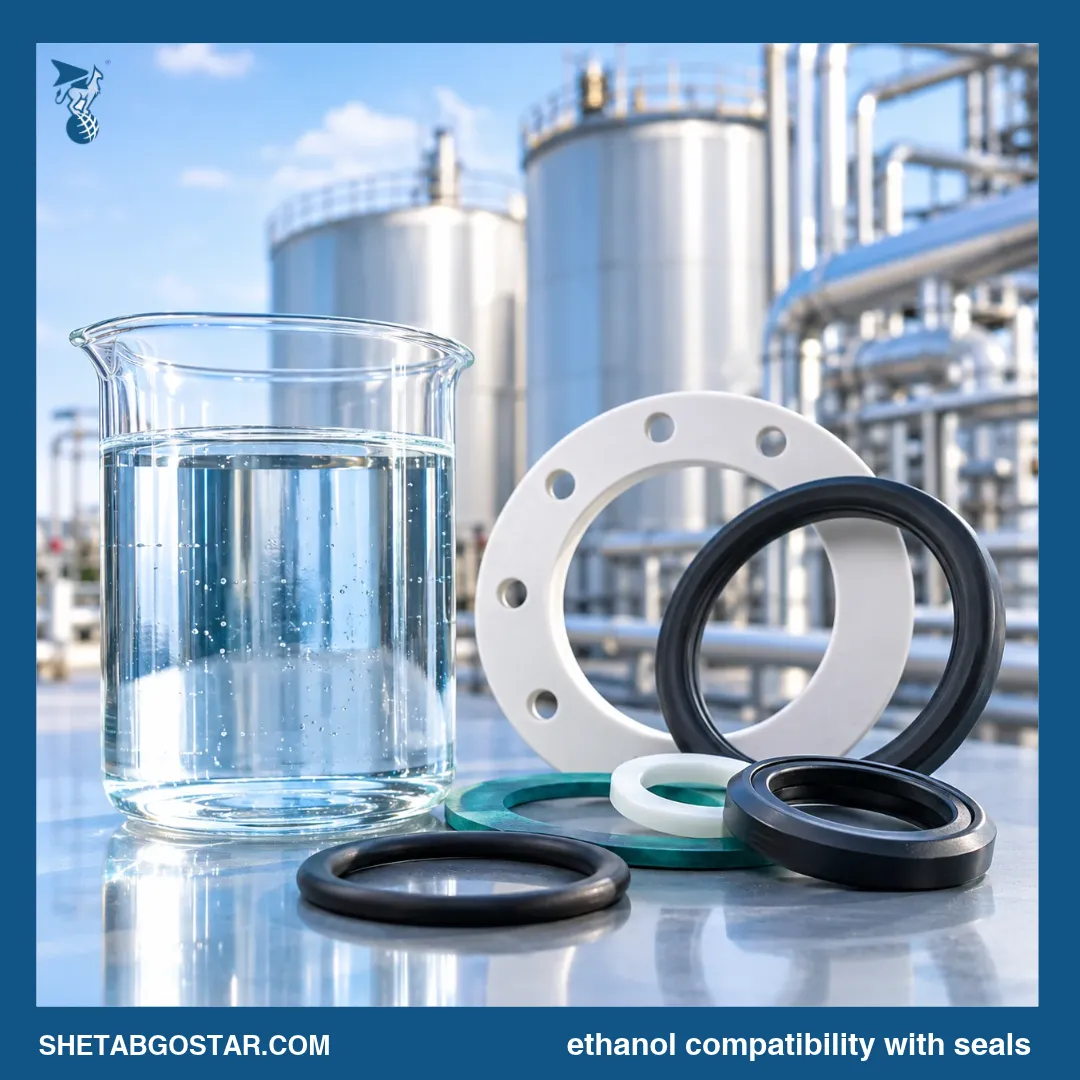
Industrial systems that handle Ethanol 96% depend on reliable sealing components to prevent leakage, maintain process efficiency, and ensure operational safety. However, prolonged exposure to ethanol can affect certain elastomers and polymeric materials. Therefore, understanding ethanol compatibility with seals is essential when designing or maintaining industrial equipment.
For a broader perspective on equipment and infrastructure requirements, explore our article on [Ethanol 96% compatibility with existing infrastructure], which discusses the challenges of using ethanol in pipelines and storage tanks.
Seals and gaskets are exposed to different operating conditions, including temperature variations, pressure changes, and continuous chemical contact. Depending on their composition, these conditions may cause swelling, hardening, loss of elasticity, or increased chemical permeation.
Selecting suitable materials requires more than simply checking whether a seal can tolerate ethanol. Engineers must also consider mechanical performance, exposure duration, operating temperature, and the specific formulation of the sealing material.
How Ethanol 96% Interacts with Sealing Materials
Ethanol 96% is a concentrated alcohol containing approximately 96% ethanol and a small proportion of water. Its chemical properties allow it to interact differently with various elastomers, plastics, and sealing compounds.
When ethanol comes into contact with a sealing material, several processes may occur:
- Chemical absorption: Ethanol molecules may enter the polymer structure and interact with its molecular chains.
- Swelling: Absorption can increase the volume and dimensions of certain elastomers.
- Material extraction: Some additives, plasticizers, or other formulation components may gradually migrate out of the material.
- Permeation: Ethanol molecules may pass through the sealing material, even when no visible leakage occurs.
- Mechanical deterioration: Repeated exposure may affect elasticity, tensile strength, and sealing performance.
The severity of these effects depends on polymer chemistry, temperature, exposure time, and the mechanical conditions of the application.
Swelling: A Major Concern in Ethanol Applications
Swelling is one of the most important factors when evaluating ethanol compatibility with seals. It occurs when a sealing material absorbs ethanol and expands beyond its original dimensions.
Although limited swelling may not immediately cause failure, excessive expansion can affect the fit between the seal and its housing.
Several operational problems may follow:
- Dimensional changes: The seal may no longer fit correctly within its designated groove.
- Increased friction: Excessive expansion can increase friction between moving components.
- Loss of sealing efficiency: Changes in material properties may reduce the seal’s ability to maintain consistent contact pressure.
- Premature failure: Repeated swelling and drying cycles can contribute to material fatigue.
The amount of swelling varies considerably between elastomer formulations. Therefore, material selection should be based on actual compatibility testing rather than general assumptions about a polymer family.
Permeation and Its Impact on Industrial Equipment
Permeation refers to the movement of ethanol molecules through a sealing material at the molecular level. Unlike leakage through a damaged seal, permeation can occur even when the component appears physically intact.
This phenomenon is particularly relevant in systems that store or transfer Ethanol 96% over extended periods.
High permeation rates can create several challenges:
- Product loss during long-term storage.
- Increased exposure of surrounding equipment to ethanol vapors.
- Changes in system pressure under certain operating conditions.
- Additional requirements for vapor containment and environmental control.
Permeation depends on material thickness, molecular structure, temperature, and the concentration of the contacting fluid.
For this reason, industrial engineers should evaluate both chemical resistance and permeation performance when selecting sealing components.
Comparing Common Seal and Gasket Materials
Different materials demonstrate different levels of resistance to ethanol exposure. However, performance can vary significantly depending on the exact compound formulation and operating conditions.
The following materials are commonly considered in industrial sealing applications.
1. EPDM (Ethylene Propylene Diene Monomer)
EPDM is frequently used in applications involving alcohols and other polar chemicals. Many EPDM formulations offer good resistance to ethanol and can maintain flexibility under suitable operating conditions.
Its advantages include:
- Good resistance to many alcohol-based fluids.
- Flexible mechanical properties.
- Resistance to weathering and aging.
- Availability in different industrial sealing grades.
However, EPDM is not suitable for every chemical environment. Compatibility should be confirmed for the specific formulation and operating temperature.
2. PTFE (Polytetrafluoroethylene)
PTFE is widely recognized for its broad chemical resistance. It generally performs well when exposed to Ethanol 96%, making it a common choice for gaskets and certain sealing applications.
Important advantages include:
- Excellent resistance to many industrial chemicals.
- Low friction characteristics.
- Low absorption and generally low permeation.
- Good performance across a relatively wide temperature range.
One limitation is its tendency to creep or cold-flow under sustained mechanical loading. Consequently, gasket design and installation conditions are important.
3. FKM (Fluoroelastomer)
FKM is commonly selected for applications requiring resistance to fuels, oils, and elevated temperatures. However, its compatibility with ethanol depends strongly on the specific formulation.
Some FKM compounds may demonstrate satisfactory performance, while others can experience changes in volume or mechanical properties when exposed to concentrated alcohol.
Engineers should therefore avoid treating all FKM grades as equally suitable for Ethanol 96%.
4. NBR (Nitrile Butadiene Rubber)
NBR is widely used in industrial seals because of its resistance to oils and fuels. However, its performance with ethanol is formulation-dependent.
Certain NBR compounds may experience swelling or changes in mechanical properties during prolonged exposure. As a result, NBR should not be selected for concentrated ethanol service without supporting compatibility data.
5. Silicone Rubber
Silicone rubber offers excellent flexibility and temperature resistance. Nevertheless, its chemical and mechanical performance in ethanol applications must be evaluated carefully.
Potential concerns include changes in mechanical strength and relatively high gas permeability compared with some alternative sealing materials.
Its suitability depends on the application, formulation, and required sealing performance.
Key Factors in Selecting Industrial Seals for Ethanol 96%
Choosing the correct sealing material involves several technical considerations beyond basic chemical resistance.
Operating Temperature
Higher temperatures can increase molecular diffusion and accelerate certain chemical interactions. A material that performs adequately at room temperature may behave differently under elevated operating temperatures.
Exposure Duration
Continuous contact with Ethanol 96% can produce different results from occasional or short-term exposure. Long-term testing is particularly important for storage tanks, pipelines, and transfer systems.
Pressure Conditions
Pressure affects the mechanical requirements of seals and gaskets. Components must maintain their structural integrity without excessive deformation or extrusion.
Mechanical Movement
Dynamic seals used in pumps and rotating equipment experience friction and repeated movement. Their requirements differ from those of static gaskets installed between stationary surfaces.
Material Formulation
Two products made from the same polymer family may have different chemical resistance because of variations in additives, fillers, curing systems, and manufacturing processes.
Practical Testing Methods for Seal Compatibility
Before introducing a new sealing material into an ethanol-handling system, manufacturers and engineers should conduct appropriate compatibility assessments.
Common evaluation methods include:
- Immersion testing: Measuring changes in mass, volume, and dimensions after controlled exposure to Ethanol 96%.
- Hardness testing: Evaluating changes in material hardness before and after exposure.
- Tensile testing: Measuring changes in tensile strength and elongation.
- Permeation testing: Assessing the rate at which ethanol passes through the material.
- Compression set testing: Determining whether a compressed seal can recover its original shape after exposure.
Standards such as ASTM D471 provide a framework for evaluating the effects of liquids on rubber materials. However, testing conditions should be selected to represent the actual industrial application.
Industrial Applications and Maintenance Considerations
Ethanol 96% is used in several industrial processes, including chemical manufacturing, pharmaceutical production, extraction operations, and solvent-based applications.
Each environment creates different requirements for sealing systems.
For example, transfer pumps require seals capable of maintaining performance under continuous movement. Storage tanks need gaskets that can tolerate prolonged contact with ethanol, while processing equipment may require materials that withstand temperature fluctuations and repeated cleaning cycles.
For additional guidance on maintaining sealing integrity and preventing ethanol leakage during storage, read our article on [Standard Storage and Warehouse Conditions to Prevent Ethanol Evaporation and Purity Loss].
Regular inspection is equally important. Signs such as surface cracking, permanent deformation, unusual swelling, and reduced elasticity may indicate that a sealing component needs replacement.
Maintenance teams should also document material specifications and operating conditions to improve future material selection decisions.
Conclusion
Understanding ethanol compatibility with seals is essential for maintaining the reliability of industrial equipment that handles Ethanol 96%. Swelling, permeation, and changes in mechanical properties can affect sealing performance and increase maintenance requirements.
Materials such as EPDM and PTFE are often considered for ethanol applications, while FKM, NBR, and silicone require careful evaluation based on their specific formulations.
Ultimately, the most reliable selection process combines chemical compatibility data, laboratory testing, and real operating conditions. Choosing the correct seals and gaskets helps reduce leakage risks, improve equipment reliability, and support more efficient ethanol handling.
Frequently Asked Questions
Which seal material is suitable for Ethanol 96%?
PTFE and many EPDM formulations are commonly considered suitable options. However, the final choice depends on operating temperature, pressure, exposure duration, and the exact material grade.
Does Ethanol 96% cause rubber seals to swell?
Yes, certain rubber formulations may absorb ethanol and experience swelling. The extent of dimensional change depends on the polymer composition and exposure conditions.
Is PTFE resistant to Ethanol 96%?
PTFE generally offers excellent chemical resistance to Ethanol 96%. However, its mechanical limitations, including creep under sustained compression, should be considered.
Why is permeation important in ethanol storage systems?
Permeation allows ethanol molecules to pass through sealing materials without visible leakage. This can contribute to product loss and vapor containment challenges.
How can industrial engineers verify seal compatibility?
Engineers can use immersion, hardness, tensile, compression set, and permeation tests to evaluate sealing materials under conditions representative of their intended applications.