Evaluating Export Caustic Soda Quality: Methods for Testing Caustic Soda 99% Purity and Impurity Control
Caustic soda is one of the most widely traded industrial chemicals, and its quality directly affects processing efficiency, product consistency, and downstream operating costs. For international buyers, Caustic Soda Quality must be verified before shipment to ensure that the material meets the agreed specification.
For Caustic Soda 99%, quality evaluation involves more than checking the sodium hydroxide percentage. A complete inspection can include total alkalinity, carbonate, chloride, iron, sulfate, moisture, physical appearance, and other parameters specified by the buyer. ASTM E291, for example, includes analytical procedures for alkalinity, carbonate, chloride, iron, and sulfate in caustic soda.
This article explains practical methods for evaluating export caustic soda, verifying Caustic Soda 99% purity, identifying common impurities, and controlling quality before international delivery.
Why Caustic Soda Quality Matters in Export
Export buyers purchase caustic soda for chemical manufacturing, pulp and paper production, alumina processing, water treatment, textiles, detergents, and other industrial applications. Each application can have specific requirements for sodium hydroxide concentration and impurity levels.
A material marketed as Caustic Soda 99% may still require additional testing because impurities can influence its performance and suitability for specific applications.
Important quality parameters may include:
- Sodium hydroxide concentration
- Sodium carbonate content
- Sodium chloride content
- Iron concentration
- Sulfate content
- Moisture or water content
- Physical appearance
- Insoluble matter
- Other impurities required by the buyer’s specification
Therefore, exporters should evaluate the complete Certificate of Analysis (COA) rather than relying only on the stated purity of the product.
How to Verify Caustic Soda 99% Purity
The first step in Caustic Soda Quality control is determining the actual sodium hydroxide concentration.
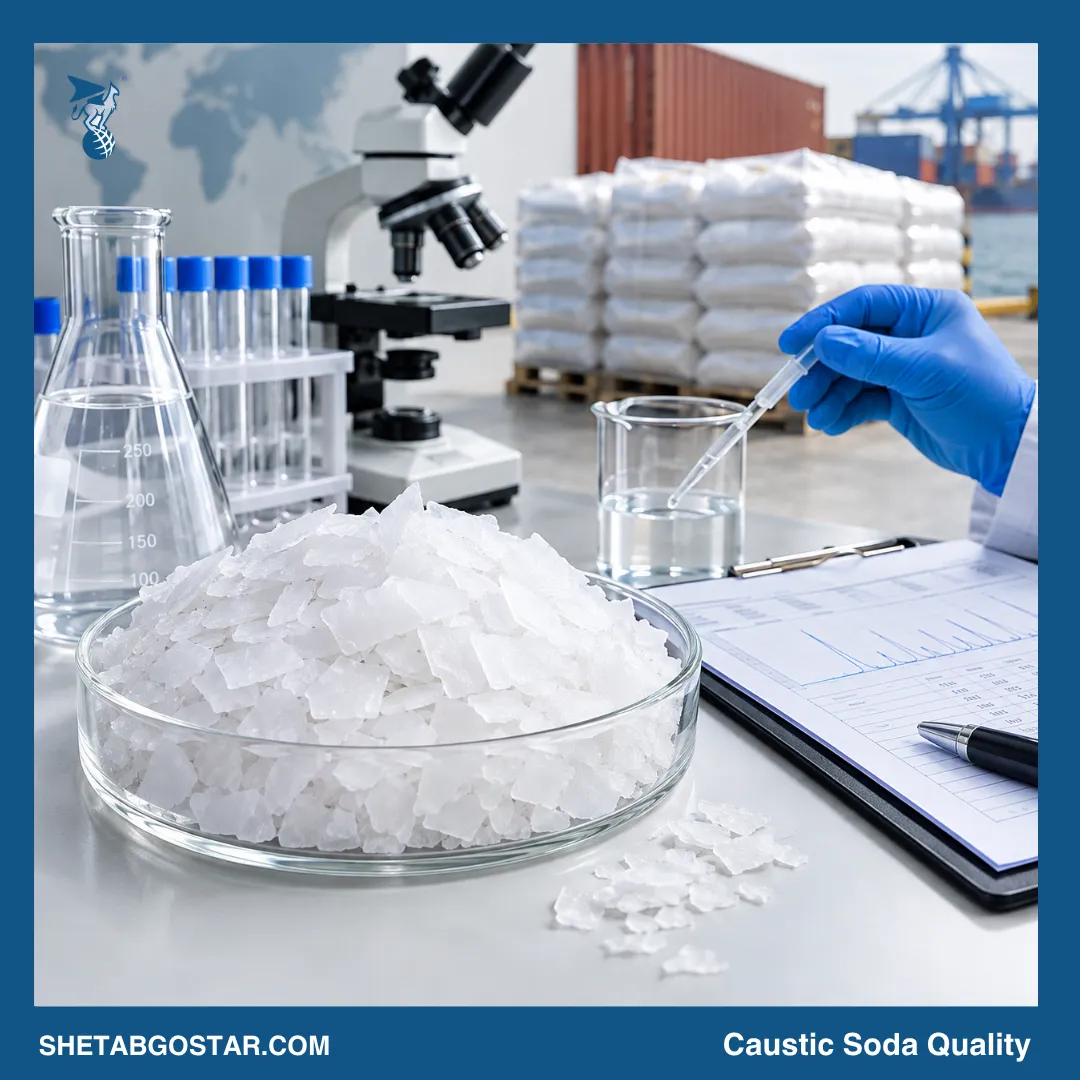
For solid caustic soda, laboratory analysis generally relies on controlled chemical testing rather than visual inspection. Titrimetric analysis can determine alkalinity and help calculate the sodium hydroxide content according to the applicable analytical procedure.
ASTM E291 includes a titrimetric procedure for total alkalinity in caustic soda with concentrations ranging from 50% to 100% NaOH, making the method relevant to high-purity products such as Caustic Soda 99%.
A typical quality-control workflow includes:
- Collect a representative sample from the shipment or production batch.
- Prepare the sample under controlled laboratory conditions.
- Determine total alkalinity using an appropriate analytical method.
- Measure relevant impurities separately.
- Compare the analytical results with the agreed product specification.
- Record the results on the Certificate of Analysis (COA).
The reported purity should always be interpreted according to the contractual specification and the analytical method used.
Testing Total Alkalinity
Total alkalinity is a fundamental parameter in caustic soda analysis because it reflects the overall alkaline content of the sample.
A laboratory can determine alkalinity through titration with a standardized acid solution. The endpoint and calculation procedure depend on the applicable analytical method.
For export quality control, laboratories should use validated procedures, calibrated equipment, suitable reagents, and documented calculations.
ASTM E291 specifically lists titrimetric analysis for total alkalinity in caustic soda and caustic potash.
Accurate alkalinity testing helps exporters determine whether Caustic Soda 99% meets the specified concentration or falls outside the agreed purity range.
Measuring Sodium Carbonate as a Key Impurity
Sodium carbonate is an important impurity in caustic soda. It can form when sodium hydroxide reacts with carbon dioxide from the surrounding environment.
The reaction can gradually convert part of the sodium hydroxide into carbonate:
2 NaOH + CO₂ → Na₂CO₃ + H₂O
As a result, exposure to atmospheric carbon dioxide can affect the chemical composition of caustic soda during handling and storage.
ASTM E291 includes both gas-volumetric and gravimetric procedures for determining carbonate in caustic soda.
Monitoring carbonate is therefore an important part of export Caustic Soda Quality control, particularly when the buyer specifies a maximum carbonate concentration for Caustic Soda 99%.
Chloride Testing in Caustic Soda
Chloride is another important impurity that may affect the suitability of caustic soda for specific industrial applications.
ASTM E291 includes several approaches for chloride analysis, including titrimetric, potentiometric, and ion-selective electrode methods.
The appropriate method depends on the chloride concentration and the characteristics of the product.
For lower concentrations, ion chromatography can also provide detailed anion analysis. ASTM E1787 covers ion chromatographic determination of several anions in caustic soda, including chloride, chlorate, sulfate, bromide, fluoride, nitrate, and phosphate.
When selecting a testing method, laboratories should consider the expected impurity level and the requirements of the applicable specification.
Iron Analysis for Export-Grade Caustic Soda
Iron can be present as a trace impurity and may become particularly important when caustic soda is intended for applications with strict color or contamination requirements.
ASTM E291 includes a photometric procedure for determining iron in caustic soda.
Quality-control laboratories should report iron using the units and detection limits required by the buyer’s specification. Where trace-level analysis is required, laboratories should ensure that sample preparation and equipment sensitivity are appropriate for the target concentration.
For Caustic Soda 99%, monitoring trace iron can help exporters demonstrate that the product complies with application-specific quality requirements.
Sulfate and Other Anionic Impurities
Sulfate is another parameter that may appear in caustic soda specifications.
ASTM E291 includes gravimetric sulfate analysis, while ASTM E1787 provides an ion chromatography method for anionic impurities such as chloride, chlorate, and sulfate.
Ion chromatography can be particularly useful when several anions need to be measured within the same analytical program.
However, the selected method should match the product concentration and the expected impurity range. Laboratories should confirm that the chosen analytical procedure is suitable for the specific caustic soda product and specification.
Physical Inspection of Caustic Soda 99%
Chemical analysis should be combined with a physical inspection before export.
For solid Caustic Soda 99%, inspectors can check:
- Color and general appearance
- Flake or solid form
- Presence of foreign materials
- Visible contamination
- Evidence of excessive moisture
- Packaging condition
- Signs of caking or deterioration
Visual inspection cannot confirm 99% purity by itself. Instead, it acts as an additional quality-control step alongside laboratory testing.
Moisture Control During Export
Moisture is particularly important when handling solid caustic soda because sodium hydroxide is highly hygroscopic. Improper storage or damaged packaging can allow the product to absorb moisture from the surrounding environment.
Moisture uptake can affect product concentration and physical condition. It can also contribute to caking and handling problems during transportation and storage.
Exporters should therefore use suitable packaging, maintain dry storage conditions, minimize unnecessary exposure to humid air, and inspect packaging before loading.
These measures help preserve the quality of Caustic Soda 99% throughout the export process.
Sampling Procedures for Export Shipments
Reliable testing starts with representative sampling.
A laboratory result is only useful when the tested sample accurately represents the shipment or production batch.
A practical sampling program should consider:
- Batch identification
- Number of bags, drums, or containers
- Sampling locations
- Sample quantity
- Clean sampling equipment
- Proper sample containers
- Sample labeling
- Chain-of-custody documentation
- Laboratory testing conditions
For large export shipments, the sampling plan should be agreed upon between the supplier, buyer, and inspection company when required by the sales contract.
Certificate of Analysis for Caustic Soda Exports
A Certificate of Analysis provides documented evidence of product quality.
For a Caustic Soda 99% shipment, a COA may include:
| Parameter | Typical Reporting Format |
|---|---|
| Sodium Hydroxide | % |
| Sodium Carbonate | % |
| Sodium Chloride | % or ppm |
| Iron | ppm |
| Sulfate | % or ppm |
| Moisture | % |
| Physical Appearance | Description |
| Batch Number | Identification |
| Production Date | Date |
| Analysis Date | Date |
| Test Method | Standard or laboratory method |
The exact parameters and acceptance limits should always follow the buyer’s specification, purchase contract, and applicable regulatory requirements.
Impurity Control from Production to Shipment
Testing alone cannot guarantee consistent Caustic Soda Quality. Exporters also need process and handling controls that reduce contamination risks.
Important controls include:
1. Production Control
Manufacturing conditions should be monitored to maintain consistent sodium hydroxide concentration and impurity levels.
2. Equipment Control
Production and transfer equipment should be compatible with caustic soda and maintained to minimize contamination.
3. Storage Control
Storage areas should protect the product from excessive humidity, contamination, and unsuitable materials.
4. Packaging Control
Packaging should remain intact throughout handling and transportation. Damaged bags or containers can expose solid caustic soda to atmospheric moisture.
5. Pre-Shipment Inspection
Before loading, exporters should verify the batch number, packaging condition, quantity, labeling, and relevant laboratory documentation.
Recommended Export Quality-Control Checklist
Before releasing a shipment of Caustic Soda 99%, exporters can use the following checklist:
- Confirm the agreed product specification.
- Verify the sodium hydroxide concentration.
- Test carbonate content.
- Check chloride concentration.
- Analyze iron when required.
- Check sulfate and other specified anions.
- Inspect physical appearance.
- Verify packaging integrity.
- Confirm batch and lot identification.
- Review the Certificate of Analysis.
- Compare laboratory results with contractual limits.
- Maintain sampling and inspection records.
This systematic approach reduces the risk of quality disputes after shipment.
Using ASTM Methods for Quality Verification
International exporters should select analytical procedures according to the product, specification, and required detection range.
ASTM E291 provides a useful framework for several core chemical analyses of caustic soda, including alkalinity, carbonate, chloride, iron, and sulfate.
For more detailed anion analysis, ASTM E1787 covers ion chromatography and can determine several anions at low concentrations. The laboratory should confirm that the method is appropriate for the specific caustic soda product, concentration, and impurity range before testing.
Using recognized analytical procedures can make quality documentation more consistent and easier for international buyers to evaluate.
Why Impurity Control Matters for International Buyers
Two shipments with similar sodium hydroxide percentages can still have different quality profiles if their impurity levels differ.
For example, elevated carbonate, chloride, iron, or sulfate may make a material unsuitable for an application with tighter impurity requirements.
For this reason, international procurement teams should define acceptance criteria before shipment instead of relying only on a general product description such as Caustic Soda 99%. Buyers can also review Caustic Soda Flakes Price in Iran to better understand how purity, quality, and export specifications relate to procurement decisions.
A clear specification should identify:
- Required NaOH concentration
- Maximum impurity limits
- Applicable test methods
- Sampling requirements
- Documentation requirements
- Packaging requirements
- Inspection requirements
- Acceptance criteria
This approach creates a measurable quality standard between supplier and buyer.
Conclusion
Reliable Caustic Soda Quality evaluation requires more than confirming a 99% sodium hydroxide claim. Exporters should combine representative sampling, laboratory analysis, impurity testing, physical inspection, packaging control, and accurate documentation.
Testing total alkalinity provides the foundation for verifying sodium hydroxide concentration, while carbonate, chloride, iron, sulfate, and other impurity analyses provide a more complete picture of product quality.
By applying a documented quality-control program from production through shipment, exporters can provide consistent Caustic Soda 99% and give international buyers the analytical information needed for technical and procurement decisions.
For reliable Caustic Soda 99% supply, work with an experienced exporter that can provide consistent product specifications, professional packaging, batch documentation, and a detailed Certificate of Analysis for every shipment.