Regional Trade Flow Analysis and Demand Dynamics Influencing Sulfuric Acid Export Markets
Introduction
Sulfuric acid export markets are strongly influenced by regional industrial activity, fertilizer production, mining, chemical manufacturing, and international logistics. As one of the most widely used industrial chemicals, sulfuric acid has demand across multiple sectors and regions.
However, international sulfuric acid trade is more complex than simply matching supply with demand. Transportation costs, production capacity, storage infrastructure, regulatory requirements, and regional industrial growth can significantly affect trade flows. Understanding these factors helps exporters and B2B buyers identify sustainable market opportunities.
What Drives Regional Sulfuric Acid Trade Flows?
Regional trade flows are primarily determined by the balance between local production and industrial consumption. Countries with large fertilizer, mining, refining, or chemical industries can generate substantial demand. Meanwhile, regions with limited domestic production may depend on imports.
Key factors affecting regional trade include:
- Fertilizer production capacity
- Mining and metal processing activity
- Chemical manufacturing
- Petroleum refining
- Local sulfur availability
- Production capacity
- Port infrastructure
- Transportation costs
- Industrial expansion
Therefore, sulfuric acid trade often develops between nearby production centers and major industrial consumers.
Fertilizer Demand and Sulfuric Acid Trade
Fertilizer manufacturing is one of the most important demand drivers for sulfuric acid. The chemical is widely used in phosphate fertilizer production and other agricultural applications.
When fertilizer production increases, sulfuric acid consumption can rise accordingly. Agricultural cycles can also influence purchasing patterns. However, fertilizer demand is affected by crop prices, energy costs, agricultural policies, and international trade conditions.
For exporters, monitoring fertilizer production trends can therefore provide useful signals about future sulfuric acid demand.
Mining and Metal Processing
Mining is another major factor influencing sulfuric acid demand in mining. Copper, nickel, uranium, and other mineral-processing operations can require significant quantities of sulfuric acid.
Regions experiencing mining expansion may therefore become attractive markets for sulfuric acid suppliers. Conversely, lower mining output can reduce regional consumption.
This creates a strong relationship between commodity prices, mining investment, and sulfuric acid demand.
Exporters should monitor new mining projects, processing facilities, and production expansions when evaluating potential markets.
Regional Production and Consumption Imbalances
Trade opportunities often emerge when production and consumption are geographically unbalanced.
A country may produce more sulfuric acid than its domestic industries require. Another market may have strong industrial demand but insufficient local production. This supply-demand gap can create opportunities for cross-border exports.
However, sulfuric acid is challenging and relatively expensive to transport because of its corrosive properties and relatively low value-to-weight ratio. As a result, geographical proximity can provide a significant competitive advantage.
Logistics and Export Competitiveness
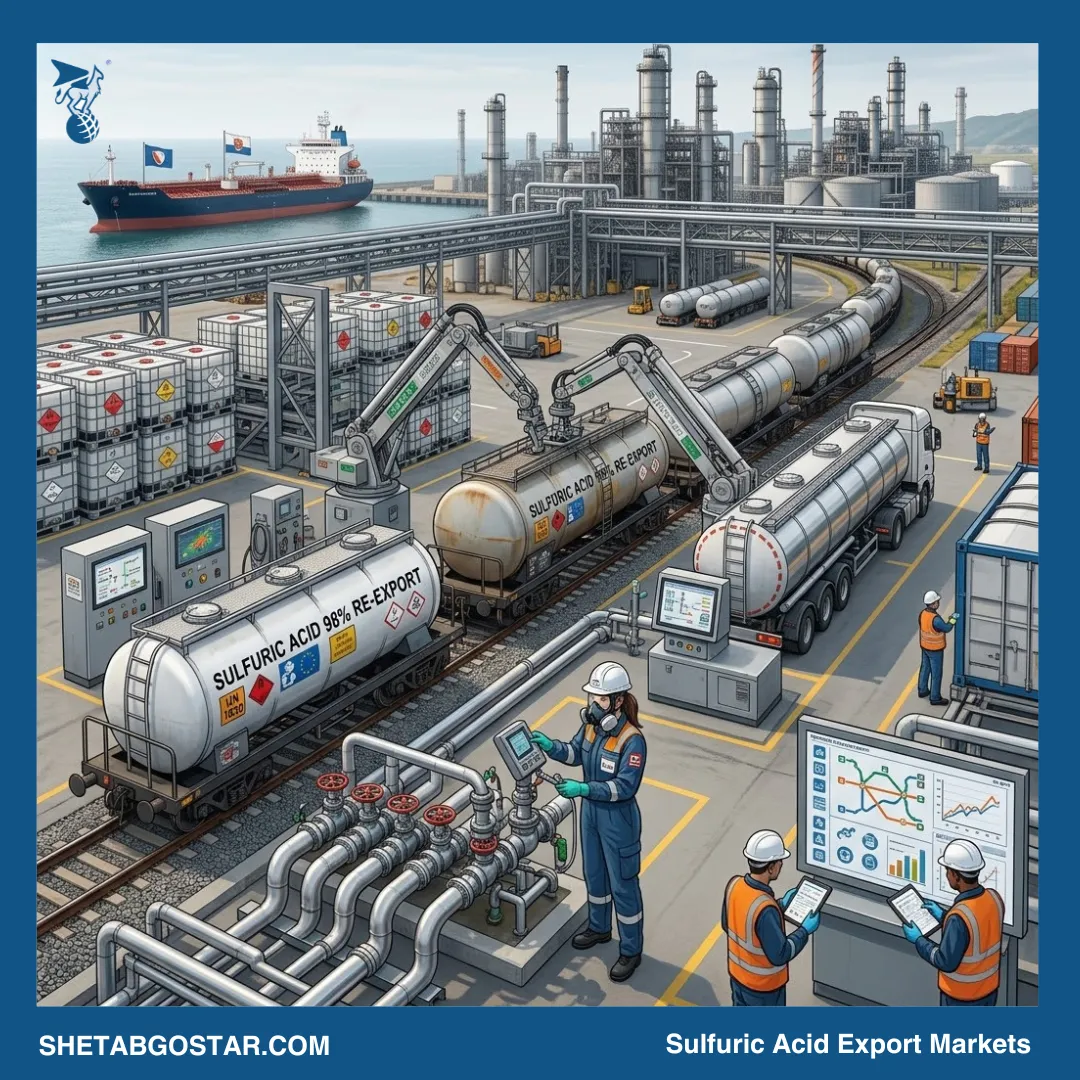
Logistics play an important role in determining the competitiveness of sulfuric acid exports. The chemical requires appropriate transportation, storage, loading, and unloading systems.
Important considerations include:
- Bulk transportation equipment
- Corrosion-resistant storage tanks
- Specialized loading facilities
- Port infrastructure
- Chemical handling procedures
- Insurance requirements
- Transportation distance
- Regulatory compliance
Freight costs can substantially affect the final delivered price. Therefore, buyers often favor suppliers that can provide reliable regional delivery and consistent logistics.
Energy and Raw Material Costs
Sulfuric acid production economics are affected by raw material availability, energy prices, plant efficiency, and production technology.
Changes in sulfur availability or energy costs can influence producer margins and consequently affect export pricing. At the same time, higher operating costs in fertilizer, mining, and chemical industries can reduce production and indirectly affect sulfuric acid demand.
For this reason, exporters should monitor both production costs and downstream industrial activity.
Regional Demand Dynamics
Demand conditions differ considerably between regions.
Asia
Asia is a major industrial and manufacturing center with significant fertilizer, mining, chemical, and metal-processing activity.
Large industrial economies can support both domestic production and international trade. However, strong local production can also reduce the need for imports.
Middle East
The Middle East has important fertilizer, petrochemical, refining, and chemical industries. Industrial expansion and investment in downstream manufacturing can create additional sulfuric acid demand.
Access to major ports and industrial zones can be particularly important when evaluating export opportunities in this region.
Europe
European sulfuric acid demand is linked to chemical manufacturing, fertilizers, metal processing, and other industrial applications.
Energy costs and production economics can strongly influence regional supply. Temporary plant shutdowns or changes in operating costs may create additional import opportunities.
Africa
Africa has potential for sulfuric acid demand growth because of expanding mining and fertilizer industries in several markets.
However, infrastructure, port capacity, inland transportation, and chemical-handling capabilities should be carefully evaluated before entering these markets.
Latin America
Mining and agriculture are major sources of industrial sulfuric acid demand in parts of Latin America. Copper production and mineral processing can create significant requirements for sulfuric acid.
Markets with expanding mining operations may therefore offer long-term opportunities for suppliers with competitive logistics.
How to Evaluate an Export Market
Exporters should evaluate several indicators before targeting a specific regional market.
1. Import Dependency
Determine whether local industries rely on imported sulfuric acid and whether domestic production can meet demand.
2. Industrial Growth
Analyze fertilizer, mining, chemical, and metal-processing investments to identify potential demand growth.
3. Domestic Production
Evaluate the capacity and reliability of existing sulfuric acid producers.
4. Logistics Infrastructure
Check port facilities, storage capacity, transportation networks, and chemical-handling infrastructure.
5. Delivered Cost
Compare production costs, freight expenses, insurance, handling charges, and other logistics costs.
6. Regulatory Environment
Review chemical import requirements, safety regulations, documentation, and applicable standards.
7. Market Stability
Determine whether demand is stable or highly dependent on seasonal or commodity-market conditions.
This structured approach helps exporters distinguish between temporary purchasing opportunities and sustainable markets.
Supply Chain Risks
International sulfuric acid trade can be affected by production outages, port congestion, transportation disruptions, geopolitical developments, and unexpected industrial shutdowns.
Supply diversification can help exporters and buyers manage these risks. Maintaining relationships with multiple suppliers can also improve procurement flexibility during periods of regional shortage.
Long-term contracts may provide additional supply security, while adequate storage capacity can help industrial buyers manage short-term disruptions.
Why Regional Proximity Matters
Sulfuric acid has a relatively low value-to-weight ratio compared with many specialty chemicals. Consequently, transportation costs can have a major impact on the final selling price.
A producer with a lower factory-gate price may not necessarily be the most competitive supplier if freight costs are significantly higher.
Therefore, regional proximity, port access, storage infrastructure, and efficient bulk logistics are critical factors in sulfuric acid export competitiveness.
Future Outlook
Future sulfuric acid trade flows are expected to remain closely connected to fertilizer production, mining investment, chemical manufacturing, and industrial development.
Key trends to monitor include:
- Growth in phosphate fertilizer production
- Expansion of copper and other metal-processing projects
- New mining investments
- Changes in global energy costs
- Chemical manufacturing expansion
- Development of port and storage infrastructure
- Regional supply disruptions
Growing demand for metals associated with energy-transition technologies may also support sulfuric acid consumption in mining and mineral-processing operations.
Conclusion
Sulfuric acid export markets are shaped by the interaction of industrial demand, regional production capacity, logistics economics, and commodity-market conditions.
Fertilizer production and mining remain major demand drivers, while transportation infrastructure and regional proximity strongly influence export competitiveness.
For B2B exporters and buyers, the most effective approach is to evaluate demand growth, import dependency, domestic production, logistics costs, infrastructure, and regulatory conditions together. This provides a more reliable basis for identifying sustainable regional export opportunities and building resilient sulfuric acid supply chains.
For reliable bulk sulfuric acid supply, working with an experienced exporter can help industrial buyers secure consistent quality, competitive pricing, and dependable international logistics.